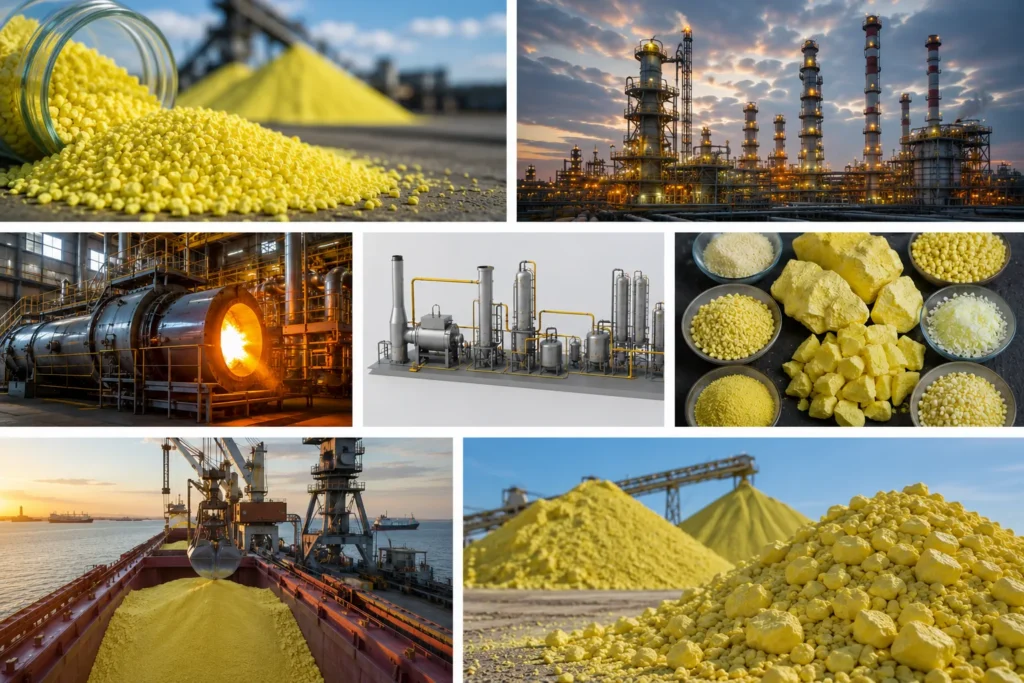
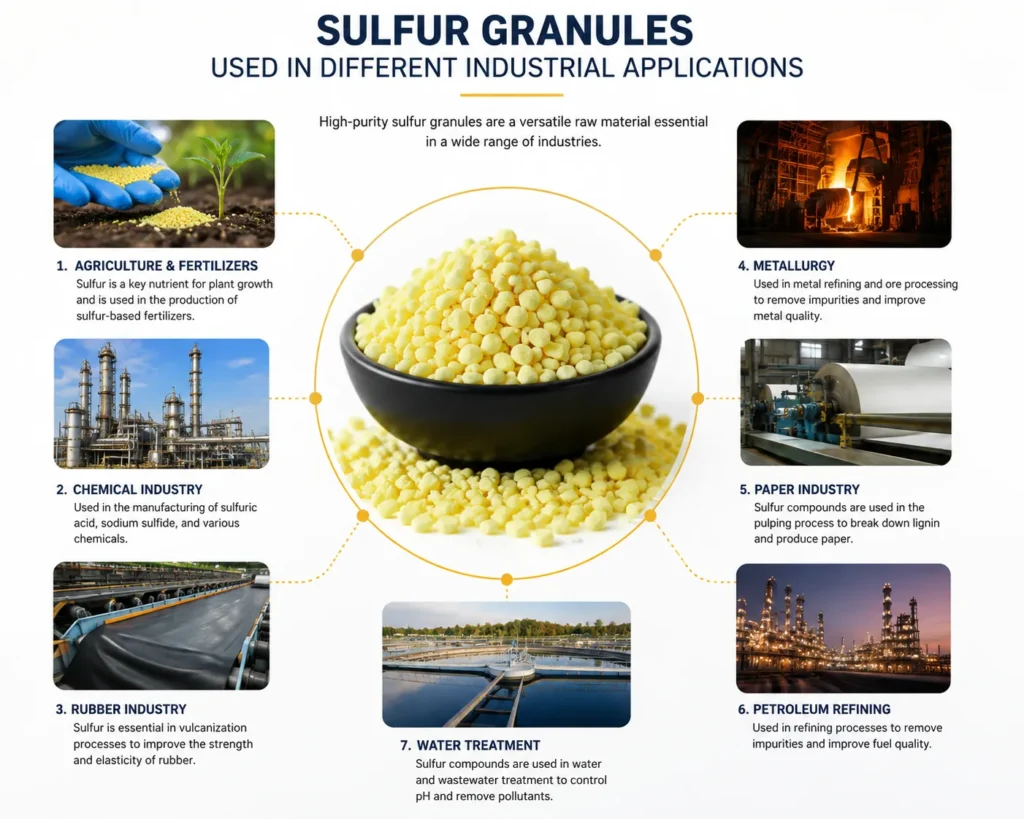
Elemental sulfur is an important industrial raw material used in fertilizer production, sulfuric acid manufacturing, petroleum refining, chemical processing, rubber production, and several other industries.
But what exactly is elemental sulfur? Where does it come from, and how is it produced on an industrial scale?
In this guide, we explain what elemental sulfur is, how elemental sulfur is produced, how the Claus process works, where sulfur is used, and what buyers should consider when sourcing elemental sulfur from an international supplier.
What Is Elemental Sulfur?
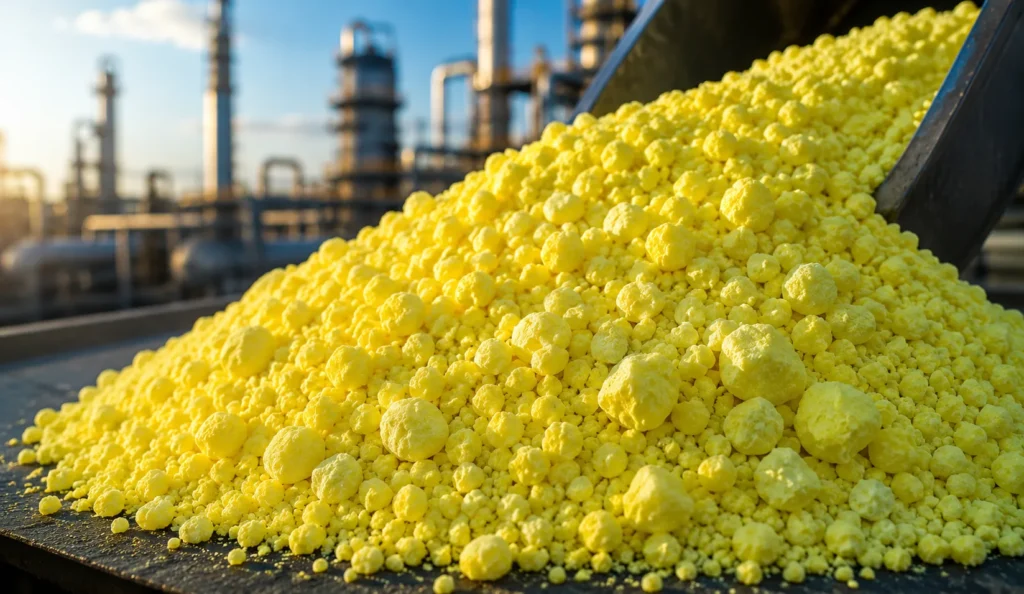
Elemental sulfur is the pure elemental form of the chemical element sulfur. Its chemical symbol is S, and its atomic number is 16.
Under normal conditions, elemental sulfur is a yellow, brittle solid. It is a nonmetallic element and occurs in several allotropes, meaning sulfur atoms can form different structural arrangements.
Elemental sulfur should be distinguished from sulfur compounds such as:
- Hydrogen sulfide (H₂S)
- Sulfur dioxide (SO₂)
- Sulfuric acid (H₂SO₄)
- Sulfates and sulfides
While these substances all contain sulfur, their chemical properties and industrial applications are different.
Elemental sulfur is particularly important in the chemical and fertilizer industries because it can be used directly in certain applications or converted into other sulfur-containing products.
For a broader introduction to sulfur, see our guide on What Is Sulfur? Properties, Uses, and Industrial Applications.
Where Does Elemental Sulfur Come From?
Elemental sulfur can occur naturally in underground deposits, volcanic areas, and other geological environments. However, a major source of modern industrial sulfur is sulfur recovery from hydrogen sulfide (H₂S) generated during natural gas processing and petroleum refining.
Crude oil and natural gas can contain sulfur compounds. During processing, these compounds are removed to produce fuels and hydrocarbon products that meet required specifications.
Hydrogen sulfide is one of the important sulfur-containing streams generated during these operations. Instead of simply treating H₂S as a waste stream, industrial facilities can recover its sulfur content and convert it into commercially valuable elemental sulfur.
According to the U.S. Environmental Protection Agency, sulfur recovery refers to the conversion of hydrogen sulfide into elemental sulfur, with the Claus process being the most common conversion method.
How Is Elemental Sulfur Produced?
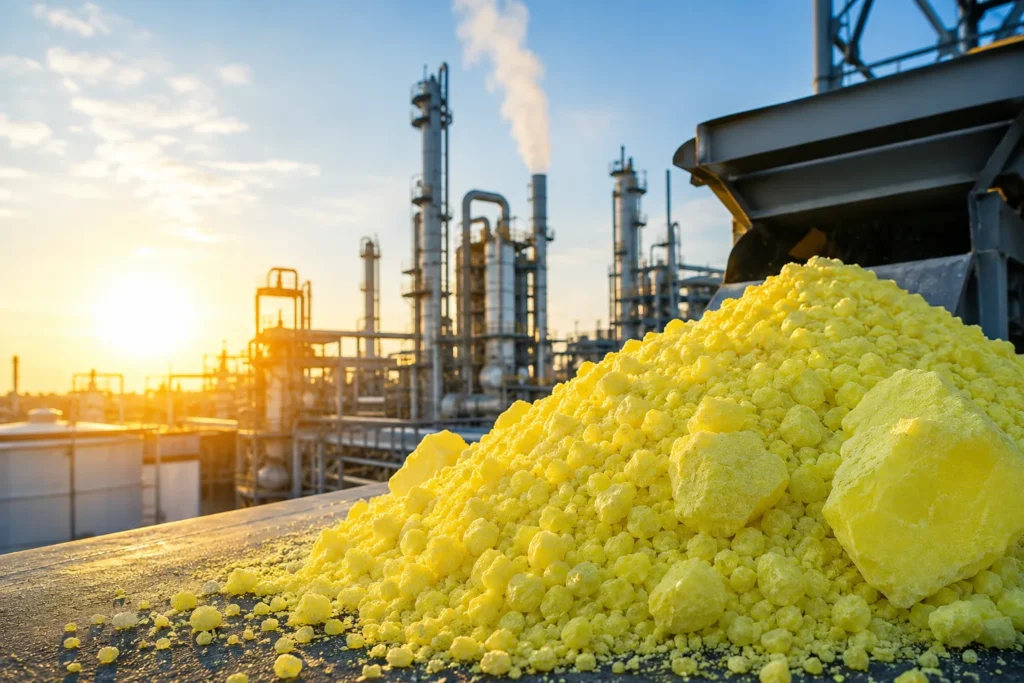
The most widely used industrial method for recovering elemental sulfur from hydrogen sulfide is the Claus process.
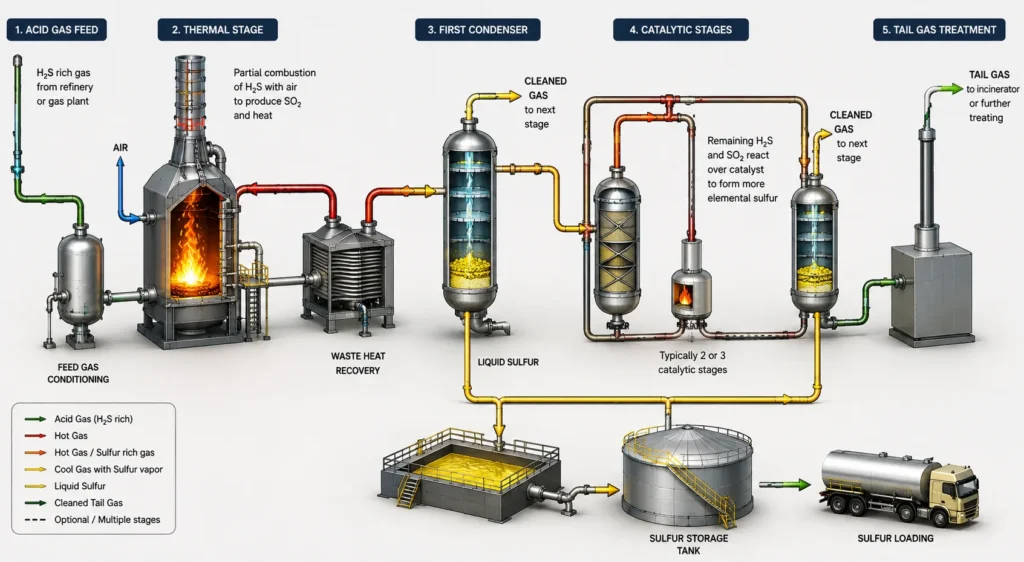
A typical Claus sulfur recovery unit, often called an SRU, converts H₂S into elemental sulfur through a combination of high-temperature combustion, catalytic reactions, cooling, and sulfur condensation.
The simplified overall reaction can be represented as:
2H₂S + O₂ → 2S + 2H₂O
The process is carefully controlled because the required ratio of hydrogen sulfide and sulfur dioxide is essential for efficient sulfur recovery.
The Claus Process Step by Step
The industrial production of elemental sulfur through the Claus process can be divided into several major stages.
1. Hydrogen Sulfide Feed
The process starts with an H₂S-containing gas stream.
Hydrogen sulfide can originate from natural gas processing or petroleum refining. The acid gas is directed to the sulfur recovery unit, where it is processed to recover its sulfur content.
2. Thermal Stage
A controlled portion of the H₂S is combusted with air in a reaction furnace.
Approximately one-third of the H₂S is oxidized to sulfur dioxide (SO₂):
2H₂S + 3O₂ → 2SO₂ + 2H₂O + heat
The reaction takes place at a high temperature, generating sulfur-containing gases and significant heat.
The hot gas is subsequently cooled, and the heat can be recovered as useful energy in the process.
The EPA describes typical Claus furnace temperatures in the range of approximately 980–1540°C, depending on process conditions.

3. Formation of Elemental Sulfur
The remaining hydrogen sulfide reacts with the sulfur dioxide produced in the thermal stage.
The main Claus reaction is:
2H₂S + SO₂ ⇌ 3S + 2H₂O + heat
This reaction produces elemental sulfur.
Because the reaction is reversible, industrial Claus plants use several process stages to increase the amount of sulfur recovered from the gas stream.
4. Sulfur Condensation
After the reaction, the process gas is cooled.
As the temperature decreases, sulfur vapor condenses into liquid sulfur. The liquid sulfur can then be separated from the remaining process gas.
The recovered liquid sulfur is collected and can subsequently be processed and handled according to the requirements of the sulfur market and end user.
5. Catalytic Stages
The remaining process gas passes through catalytic reactors.
In these stages, additional H₂S and SO₂ react to form more elemental sulfur.
The gas is reheated before entering catalytic reactors and cooled afterward so that the newly formed sulfur can be condensed and removed.
A typical Claus unit can contain multiple catalytic stages. The number of stages depends on the required sulfur recovery performance and the characteristics of the feed stream.
What Is a Sulfur Recovery Unit (SRU)?
A Sulfur Recovery Unit (SRU) is an industrial facility designed to recover elemental sulfur from sulfur-containing gas streams, primarily hydrogen sulfide.
SRUs are commonly associated with:
- Oil refineries
- Natural gas processing plants
- Petrochemical facilities
- Other industrial facilities that generate H₂S-containing streams
The SRU typically includes a thermal reaction furnace, sulfur condensers, catalytic reactors, reheaters, and associated equipment.
The main objective is to recover sulfur efficiently while reducing the amount of sulfur-containing compounds remaining in the process gas.
The Claus process is responsible for the majority of industrial sulfur recovery from H₂S-containing streams.
What Happens to the Sulfur After Production?
Once elemental sulfur has been recovered and separated, it can be stored, transported, and supplied for industrial applications.
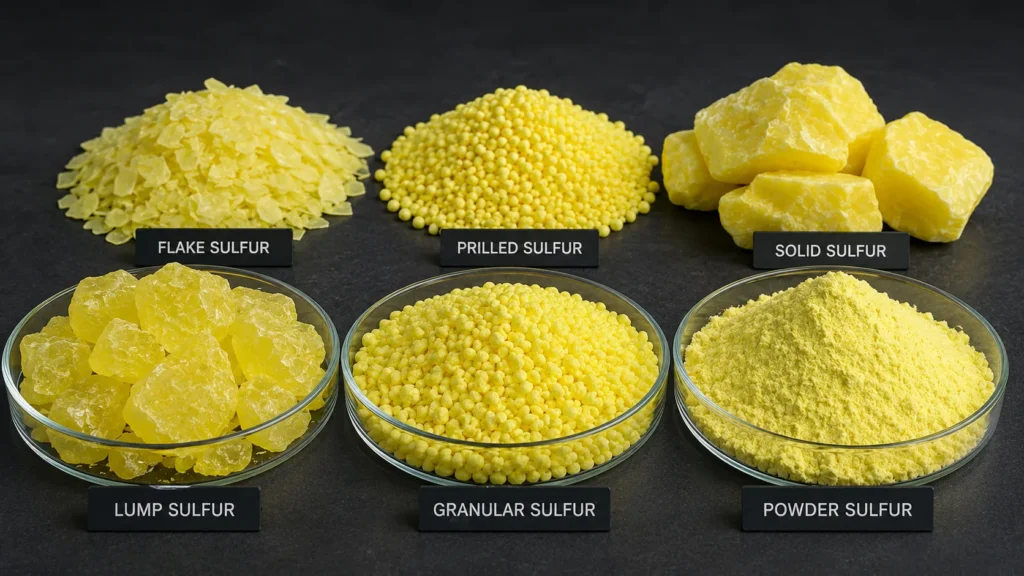
Depending on the production facility and commercial requirements, sulfur can be handled in different physical forms.
Common commercial forms may include:
- Granular sulfur
- Lump sulfur
- Powdered sulfur
- Flaked sulfur
- Prilled sulfur
- Liquid sulfur
The appropriate form depends on the intended application, transportation requirements, storage conditions, and customer’s specifications.
What Is Elemental Sulfur Used For?
Elemental sulfur has a wide range of industrial applications.
Its largest and most important downstream application is related to sulfuric acid production, while sulfur is also used in fertilizers, rubber processing, chemicals, and other industrial products.
1. Sulfuric Acid Production
One of the most important applications of elemental sulfur is the production of sulfuric acid.
Sulfur can be burned to produce sulfur dioxide, which is then further oxidized and processed to manufacture sulfuric acid.
Sulfuric acid is one of the world’s most important industrial chemicals and is used in fertilizer manufacturing, chemical processing, petroleum refining, metal processing, and many other applications.
2. Fertilizer Industry
Sulfur plays an important role in agriculture and fertilizer production.
Elemental sulfur can be used in sulfur-containing agricultural products or processed into sulfuric acid for fertilizer manufacturing.
Because sulfur is an essential plant nutrient, sulfur-based products have an important role in agricultural applications.
For more information, read our article:
Sulfur Uses in Different Industries: Industrial Applications and Benefits
3. Rubber Vulcanization
Sulfur is widely used in the rubber industry for vulcanization.
During vulcanization, sulfur helps create cross-links within rubber polymers. This process can improve properties such as elasticity, strength, durability, and resistance to deformation.
4. Chemical Manufacturing
Elemental sulfur is also used as a raw material in the production of various sulfur-containing chemicals.
Its chemical properties make it useful as an industrial feedstock in different chemical processes.
5. Petroleum and Refining Industries
Although petroleum refining is a major source of recovered elemental sulfur, sulfur also plays an important role in processes associated with the petroleum industry.
Sulfur recovery allows refineries to convert sulfur-containing compounds removed from hydrocarbon streams into a useful commercial material.
Elemental Sulfur vs. Other Sulfur Products
Understanding the difference between elemental sulfur and other sulfur-containing materials is important when purchasing sulfur.
| Product | Chemical Formula | Description |
|---|---|---|
| Elemental sulfur | S | Elemental form of sulfur used as an industrial raw material |
| Hydrogen sulfide | H₂S | Sulfur-containing gas commonly processed in sulfur recovery units |
| Sulfur dioxide | SO₂ | Intermediate produced during sulfur combustion and Claus processing |
| Sulfuric acid | H₂SO₄ | Major industrial chemical produced from sulfur-containing feedstocks |
Elemental sulfur is therefore not the same product as sulfuric acid or hydrogen sulfide.
When requesting a quotation from a supplier, buyers should clearly specify that they require elemental sulfur and provide their required grade and physical form where applicable.
What Should You Consider When Buying Elemental Sulfur?
For industrial buyers, selecting sulfur based only on price can create problems later in the supply chain.
Several technical and commercial factors should be considered before placing an order.
Sulfur Purity
The required sulfur purity depends on the application.
Buyers should request the relevant technical specification and Certificate of Analysis (COA) before confirming a purchase.
Physical Form
The physical form of sulfur can affect:
- Handling
- Storage
- Transportation
- Feeding into production equipment
- Dust generation
- Processing requirements
For this reason, buyers should specify whether they require granular, lump, powder, prilled, flaked, or another form.
Moisture and Impurities
Moisture and impurities can affect product handling and downstream processing.
A reliable supplier should be able to provide appropriate product documentation and specifications.
Packaging
Sulfur can be supplied in different packaging configurations depending on the product form, order size, transportation method, and customer’s requirements.
Packaging should therefore be agreed upon before shipment.
Quantity and Delivery
International sulfur buyers should also consider:
- Required quantity
- Delivery destination
- Shipping method
- Loading conditions
- Delivery schedule
- Export documentation
- Inspection requirements
These factors can significantly affect the final purchasing decision.
How to Choose an Elemental Sulfur Supplier
Finding an appropriate elemental sulfur supplier is an important step for companies purchasing sulfur internationally.
Before selecting a supplier, buyers should evaluate:
- Product specification
- Sulfur purity
- Physical form
- Certificate of Analysis
- Product origin
- Packaging options
- Available quantity
- Loading and shipping options
- Export documentation
- Delivery capability
A professional trading company can help coordinate the sourcing process and connect buyers with suitable supply options.
Buying Elemental Sulfur from SmartPath
SmartPath General Trading Group provides international trading and sourcing services for petrochemical, chemical, polymeric, and fertilizer raw materials.
For customers interested in sourcing elemental sulfur, SmartPath can support the commercial process by helping coordinate product sourcing, quality documentation, inspection, packaging, and international logistics according to the specific requirements of the transaction.
Because sulfur specifications and commercial requirements can vary between applications, customers should provide their required quantity, destination, physical form, and technical specifications when requesting a quotation.
Looking for an Elemental Sulfur Supplier?
If your company is looking to buy elemental sulfur for fertilizer production, sulfuric acid manufacturing, chemical processing, rubber production, or another industrial application, contact the SmartPath team.
We can discuss your requirements and help identify a suitable sourcing solution.
Request an Elemental Sulfur Quotation

Frequently Asked Questions About Elemental Sulfur
What is elemental sulfur?
Elemental sulfur is the uncombined elemental form of sulfur, represented by the chemical symbol S. It is normally a yellow, brittle solid and is widely used as an industrial raw material.
How is elemental sulfur produced?
Most industrial recovered sulfur is produced by converting hydrogen sulfide (H₂S) into elemental sulfur through the Claus process. The process combines thermal combustion, catalytic reactions, cooling, and sulfur condensation.
What is the Claus process?
The Claus process is an industrial sulfur recovery process that converts hydrogen sulfide into elemental sulfur. It uses controlled oxidation followed by catalytic reactions to recover sulfur from H₂S-containing gas streams.
Where does industrial sulfur come from?
A major source of industrial elemental sulfur is sulfur recovery from natural gas processing and petroleum refining. Sulfur-containing compounds are removed during processing, and H₂S can subsequently be converted into elemental sulfur.
What is elemental sulfur used for?
Elemental sulfur is primarily used in sulfuric acid production and is also important in fertilizer manufacturing, rubber vulcanization, chemical production, and other industrial applications.
What forms of elemental sulfur are available?
Commercial sulfur can be supplied in different forms, including granules, lumps, powder, flakes, prills, and liquid sulfur, depending on the producer and application.
What should I check before buying elemental sulfur?
Buyers should check sulfur purity, physical form, particle size where relevant, moisture, impurities, packaging, Certificate of Analysis, origin, quantity, and delivery requirements.
Can I request a quotation for elemental sulfur from SmartPath?
Yes. Companies interested in sourcing elemental sulfur can contact SmartPath with their required quantity, destination, application, physical form, and available technical specifications.
Contact SmartPath for an Elemental Sulfur Inquiry
Conclusion
Elemental sulfur is an important industrial raw material used across fertilizer production, sulfuric acid manufacturing, petroleum refining, rubber processing, and chemical manufacturing.
A significant amount of industrial sulfur is recovered from hydrogen sulfide generated during natural gas processing and petroleum refining. The Claus process is the principal industrial technology used to convert H₂S into elemental sulfur through thermal and catalytic reactions.
For industrial buyers, choosing the right sulfur product requires more than comparing prices. Product specifications, purity, physical form, documentation, packaging, quantity, logistics, and delivery requirements should all be considered before purchasing.
If you are looking for an elemental sulfur supplier for your industrial or commercial requirements, contact SmartPath to discuss your needs and request a quotation.