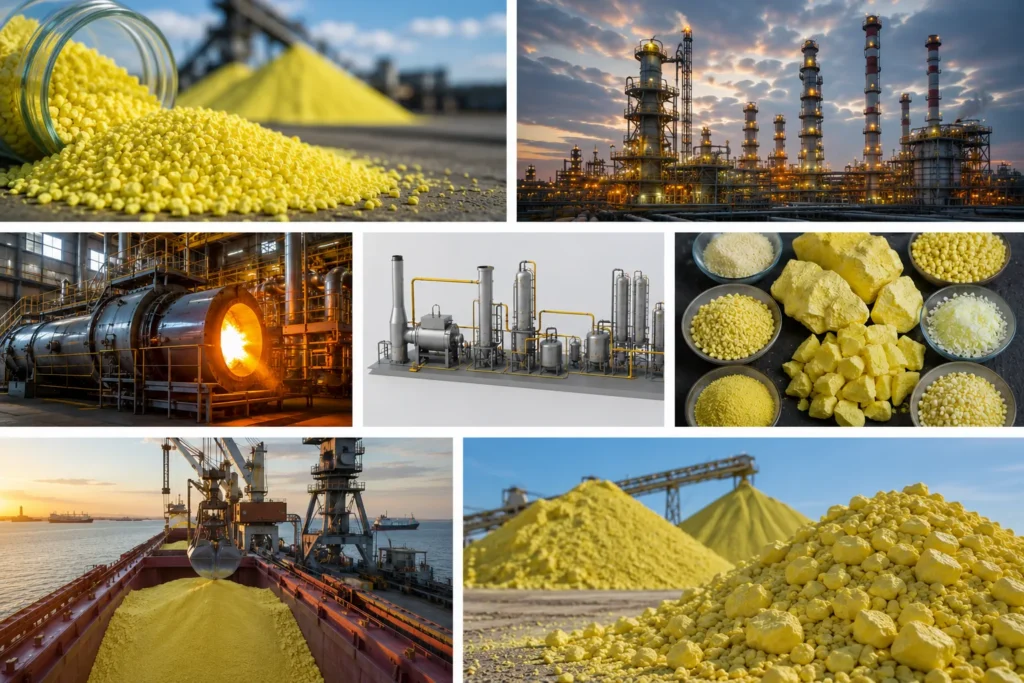
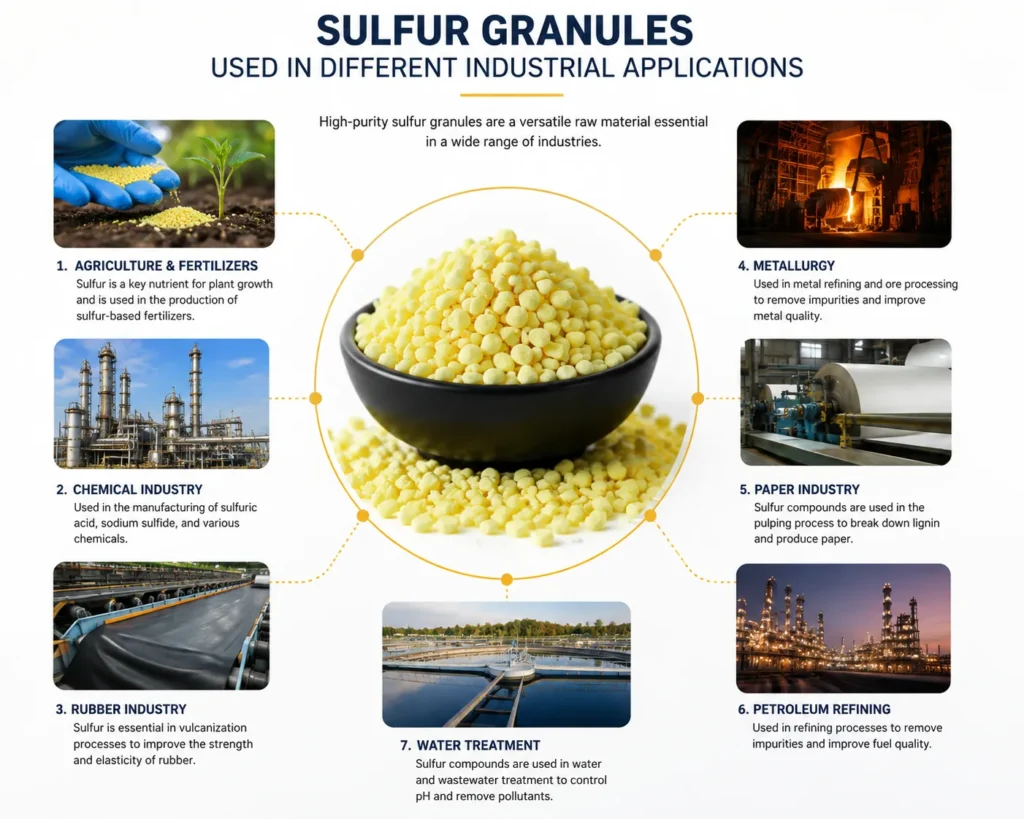
Sulfur is a naturally occurring chemical element with the symbol S and atomic number 16. Best known for its bright yellow color, sulfur is a nonmetal that plays an important role in modern industry. It is widely used as a raw material for producing sulfuric acid, fertilizers, rubber products, chemicals, and a variety of industrial materials.
For industrial buyers, sulfur is more than a chemical element. It is an important industrial raw material available in different forms and specifications depending on the intended application. Choosing the right sulfur product requires attention to purity, physical form, packaging, handling requirements, and supply reliability.
In this guide, we explain what sulfur is, its physical and chemical properties, major sulfur uses, industrial applications, common sulfur forms, and important considerations when sourcing sulfur for industrial purposes.
Looking for Industrial Sulfur for Your Business?
Contact our team to discuss sulfur specifications, available grades,
packaging, and supply options.
Request a Sulfur Quotation
What Is Sulfur?
Sulfur is a chemical element classified as a nonmetal and belongs to Group 16 of the periodic table. Its chemical symbol is S, and its atomic number is 16.
At room temperature, elemental sulfur is normally a solid with a characteristic yellow appearance. According to the Royal Society of Chemistry, sulfur has a relative atomic mass of approximately 32.06, a melting point of about 115.21°C, and a boiling point of approximately 444.61°C.
Sulfur can occur naturally in elemental form and is also present in many minerals and sulfur-containing compounds. Commercial elemental sulfur is commonly recovered during the processing and refining of fossil fuels, particularly in oil refining and natural gas processing.
Because of its chemical characteristics and wide range of derivatives, sulfur has become an important feedstock for several major industrial sectors.
Sulfur at a Glance
| Property | Sulfur |
|---|---|
| Chemical symbol | S |
| Atomic number | 16 |
| Relative atomic mass | 32.06 |
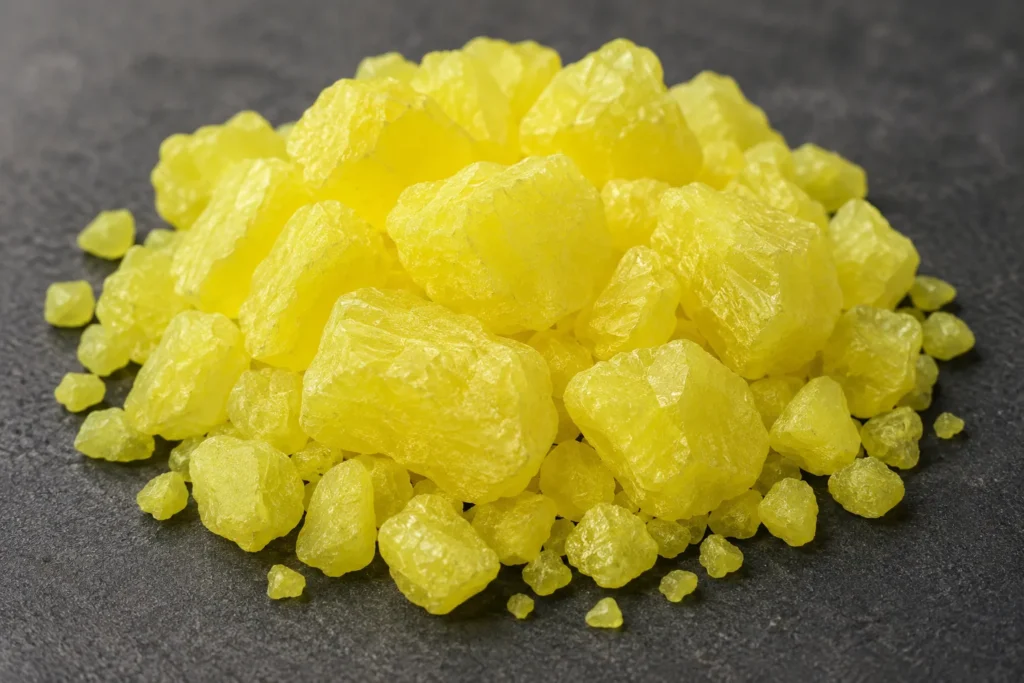
| Appearance | Yellow solid |
| Physical state at room temperature | Solid |
| Melting point | Approximately 115.21°C |
| Boiling point | Approximately 444.61°C |
| CAS Number | 7704-34-9 |
| Classification | Nonmetal |
Key Properties of Sulfur
Understanding sulfur properties is important when selecting sulfur for industrial applications.
1. Physical Appearance
Elemental sulfur is commonly recognized as a yellow solid. Depending on its production method and commercial form, sulfur can be supplied as powder, granules, pellets, flakes, or other forms.
For industrial applications, physical form can be just as important as chemical purity because it affects handling, storage, transportation, feeding, and processing.
2. Melting Point
Sulfur melts at approximately 115.21°C.
This relatively low melting point is important in industrial operations where sulfur may be melted, transferred, processed, or incorporated into chemical production processes.
3. Chemical Reactivity
Sulfur participates in a wide range of chemical reactions and can form numerous sulfur-containing compounds.
One of its most important industrial transformations is its conversion into sulfuric acid (H₂SO₄), a major industrial chemical used in fertilizer manufacturing and numerous other processes.
4. Insolubility in Water
Elemental sulfur has very low solubility in water. Its behavior in different solvents and chemical environments is one of the characteristics that makes sulfur useful in specialized industrial processes.
5. Different Allotropic Forms
Sulfur can exist in different structural forms known as allotropes. The properties of sulfur can vary depending on its molecular and physical structure.
For commercial applications, however, buyers generally focus on factors such as purity, particle size, physical form, moisture, ash, acidity, and other specification requirements rather than the basic chemical identity of sulfur.
Where Does Sulfur Come From?
Sulfur can occur naturally, but modern commercial sulfur production is strongly connected to petroleum refining and natural gas processing.
During the processing of crude oil and natural gas, sulfur-containing compounds can be removed to meet fuel and environmental requirements. The recovered sulfur can then be processed and marketed as elemental sulfur.
USGS identifies petroleum refining and natural gas processing as important sources of elemental sulfur production.
This means that sulfur recovered as part of industrial processing can become a valuable raw material for other industries.
What Is Sulfur Used For?
Sulfur has a remarkably broad range of applications. Its largest industrial role is as a raw material for sulfuric acid production, which in turn supports fertilizer manufacturing and many other industrial processes.
Major sulfur uses include:
- Sulfuric acid production
- Fertilizer manufacturing
- Agriculture and soil treatment
- Rubber vulcanization
- Chemical manufacturing
- Mining and metal processing
- Pulp and paper applications
- Petroleum and petrochemical industries
- Fungicides and agricultural chemicals
- Specialized industrial and chemical applications
1. Sulfur in Sulfuric Acid Production
One of the most important applications of elemental sulfur is the production of sulfuric acid.
Sulfuric acid is one of the world’s most important industrial chemicals and is used in fertilizer production, mineral processing, petroleum refining, chemical manufacturing, batteries, and many other industrial applications. USGS identifies sulfuric acid production as the major end use for sulfur.
A simplified industrial pathway is:
Elemental Sulfur → Sulfur Dioxide → Sulfur Trioxide → Sulfuric Acid
The importance of sulfur in this application makes sulfur quality, purity, and consistent supply particularly important for industrial chemical manufacturers.
Sulfuric Acid Production: Process, Raw Materials, and Industrial Applications
2. Sulfur for Fertilizer Manufacturing
The fertilizer industry is one of the largest users of sulfur because sulfuric acid is essential in the production of several phosphate fertilizers.
Sulfur also plays a direct role in plant nutrition. It is a component of amino acids, proteins, and other biological compounds required for plant growth. USGS notes that sulfur can be applied in agricultural systems in forms including elemental sulfur and sulfur-containing fertilizers.
Sulfur therefore serves two important roles in agriculture:
- As a raw material for fertilizer production
- As a source of sulfur for plant nutrition
For fertilizer manufacturers, reliable access to industrial sulfur can be an important part of maintaining consistent production.
3. Sulfur in Agriculture
Elemental sulfur is also used directly in agriculture.
Depending on the application and formulation, sulfur may be used to provide sulfur nutrients to crops or to help manage soil conditions. Sulfur-containing agricultural products can be formulated in different ways to control application and improve effectiveness.
The appropriate sulfur product depends on factors such as:
- Soil conditions
- Crop requirements
- Particle size
- Application method
- Product purity
- Formulation
- Local agricultural requirements
4. Sulfur for Rubber Vulcanization
Another major industrial use of sulfur is rubber vulcanization.
Sulfur is used to create cross-links within rubber polymers, improving important characteristics such as strength, elasticity, durability, and resistance to deformation.
Sulfur-based vulcanization is widely associated with the production of rubber products, including tires and other industrial rubber components. The Royal Society of Chemistry and USGS both identify rubber vulcanization among the established uses of sulfur.
For rubber manufacturers, sulfur specifications can be critical because impurities and physical characteristics may affect processing and final product performance.
5. Sulfur in Chemical Manufacturing
Sulfur is an important feedstock for the production of numerous sulfur-containing chemicals.
Depending on the industrial process, sulfur can be converted into different sulfur compounds and intermediates used throughout the chemical industry.
Its chemical versatility makes elemental sulfur valuable not only as a final industrial material but also as a starting raw material for downstream chemical production.
6. Sulfur in Mining and Metal Processing
Sulfur and sulfur-derived chemicals are used in several areas of mineral processing and metallurgy.
Sulfuric acid, produced from sulfur, is particularly important in mineral processing and hydrometallurgical operations where acidic solutions are used to extract or process metals.
This creates an important connection between the sulfur supply chain and the mining industry.
7. Sulfur in Petroleum and Petrochemical Industries
The petroleum industry is both an important source of elemental sulfur and a consumer of sulfur-derived chemicals.
During petroleum refining, sulfur-containing compounds are removed from fuels and other hydrocarbon streams. Recovered sulfur can then enter the industrial market as a useful raw material.
This recovery process turns sulfur removal from a refining requirement into a source of commercially valuable elemental sulfur.
Industrial Applications of Sulfur
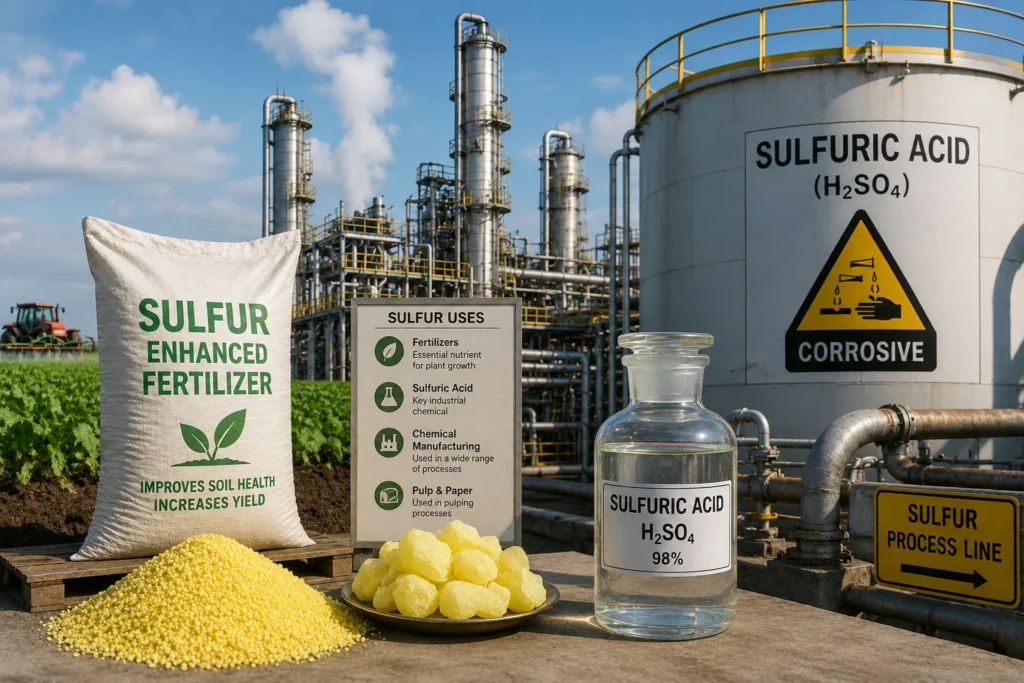
The industrial applications of sulfur extend across multiple sectors.
| Industry | Main Sulfur Application |
| Fertilizer | Sulfuric acid and sulfur-containing fertilizers |
| Chemical | Production of sulfur compounds and intermediates |
| Rubber | Vulcanization |
| Agriculture | Soil and plant nutrition applications |
| Mining | Sulfuric acid and mineral processing |
| Petroleum | Refining and sulfur recovery |
| Manufacturing | Chemical and material processing |
| Pulp & Paper | Selected sulfur-based chemical processes |
What Are the Different Forms of Sulfur?
Industrial sulfur is available in several physical forms. The most suitable form depends on the application, production process, transportation requirements, and customer’s equipment.
Common commercial forms may include:
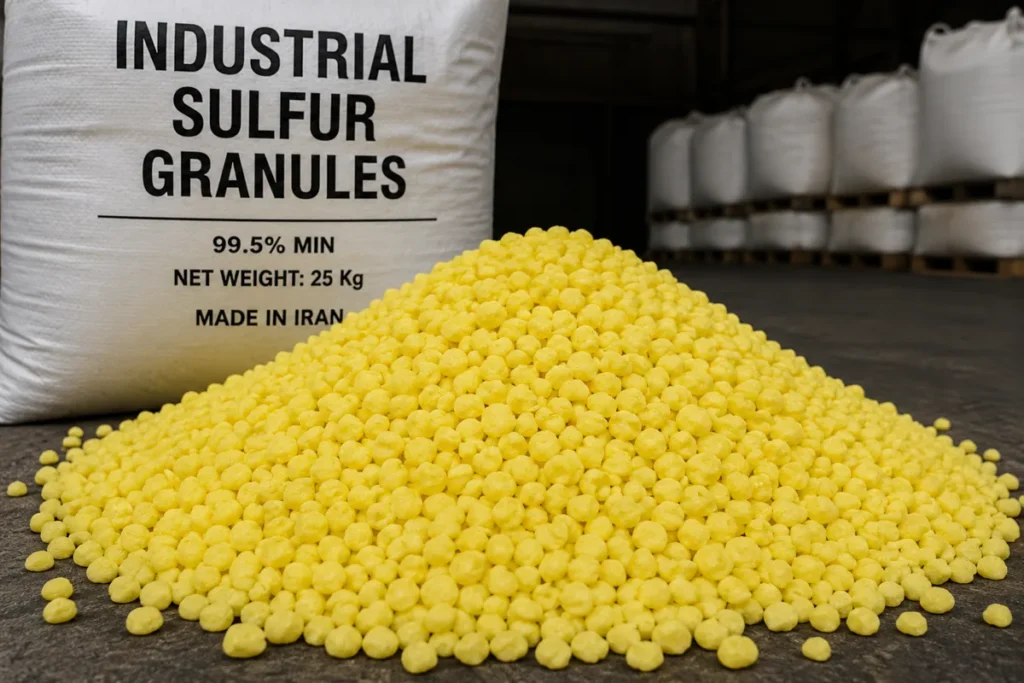
Sulfur Granules
Granular sulfur is designed for convenient handling, storage, transportation, and industrial use.
Sulfur Prills
Sulfur prills are small solid particles produced through controlled industrial processes. They are commonly selected when consistent particle size and handling characteristics are important.
Sulfur Powder
Powdered sulfur has a much smaller particle size and can be suitable for applications where rapid dispersion or mixing is required.
Sulfur Flakes
Sulfur flakes are another commercial form that can be used in chemical, agricultural, and industrial applications depending on product specifications.
What Should You Consider When Buying Industrial Sulfur?
Choosing an industrial sulfur supplier should involve more than comparing the lowest price.
For industrial buyers, product consistency, specifications, logistics, documentation, and supply reliability can have a significant effect on production costs and operational efficiency.
Before purchasing sulfur, consider the following factors.
Sulfur Purity
Purity is one of the most important specifications when purchasing elemental sulfur.
Depending on the application, buyers may require high-purity sulfur with controlled levels of impurities.
Physical Form
Choose the physical form according to your production and handling system.
Granules, prills, flakes, and powder can have different handling and processing characteristics.
Particle Size
Particle size can affect handling, mixing, dissolution, dispersion, and application performance.
Moisture Content
Moisture can influence storage, transportation, handling, and product performance. Industrial buyers should review moisture specifications before placing an order.
Packaging
Sulfur can be transported and supplied in different packaging formats depending on quantity, destination, storage facilities, and customer requirements.
Documentation and Quality Control
For international industrial trade, buyers may require documents such as:
- Certificate of Analysis (COA)
- Safety Data Sheet (SDS)
- Technical Data Sheet (TDS)
- Certificate of Origin
- Commercial Invoice
- Packing List
- Other shipping or compliance documents
How to Choose a Reliable Sulfur Supplier
Selecting the right sulfur supplier is especially important for companies purchasing sulfur in commercial or bulk quantities.
A reliable supplier should be able to provide clear product specifications, consistent quality, appropriate packaging, and dependable logistics.
Before working with a sulfur supplier, consider asking:
- What sulfur purity is available?
- What physical forms are available?
- What are the typical impurity levels?
- What packaging options are available?
- What minimum order quantity applies?
- What destinations can be supplied?
- Can the supplier provide a Certificate of Analysis?
- What are the available delivery terms?
- How is the product handled during transportation?
- Can the supplier support recurring or bulk orders?
Why Sulfur Quality Matters for Industrial Buyers
Sulfur quality can directly affect downstream industrial processes.
For example, chemical manufacturers may require specific purity levels, while agricultural or rubber applications may have different requirements for particle size, physical form, or processing characteristics.
Using a sulfur product that matches the required technical specification can help manufacturers maintain more consistent production and reduce unnecessary processing problems.
For this reason, buyers should evaluate sulfur based on the complete specification, not only the headline purity percentage.
At SmartPath, we help industrial buyers source sulfur according to their required specifications, application, quantity, and destination.
Sulfur Supply for Industrial Buyers
If you are looking to purchase sulfur for industrial use, the right product depends on your application and purchasing requirements.
Whether you need sulfur for fertilizer manufacturing, sulfuric acid production, rubber processing, agriculture, chemical manufacturing, or another industrial application, it is important to confirm the required product specifications before ordering.
Need Sulfur for Your Industrial Operation?
We can help you identify the appropriate sulfur specification based on your application, required quantity, packaging, and destination.
Request a sulfur quotation today and discuss your requirements with our sales team.
Frequently Asked Questions About Sulfur
What is sulfur?
Sulfur is a nonmetallic chemical element with the symbol S and atomic number 16. It is commonly found as a yellow solid and is widely used as an industrial raw material.
What is sulfur mainly used for?
The largest industrial use of sulfur is the production of sulfuric acid. Sulfur is also used in fertilizer manufacturing, agriculture, rubber vulcanization, chemical manufacturing, and other industrial applications.
Is sulfur used to make fertilizer?
Yes. Sulfur is important in fertilizer production, particularly because sulfuric acid is widely used to process phosphate rock. Elemental sulfur is also used directly in agriculture as a sulfur source for plants.
Is sulfur used in rubber?
Yes. Sulfur is widely used as a vulcanizing agent in rubber manufacturing, helping create cross-links that improve the performance and durability of rubber products.
What is elemental sulfur?
Elemental sulfur refers to sulfur in its elemental form, consisting primarily of sulfur rather than being chemically combined with another element. It is an important industrial raw material and is commercially supplied in different physical forms.
Where does industrial sulfur come from?
A major source of commercial elemental sulfur is the recovery of sulfur during petroleum refining and natural gas processing.
What is the melting point of sulfur?
The melting point of sulfur is approximately 115.21°C (239.38°F).
How do I choose the right sulfur product?
The appropriate sulfur product depends on the intended application, purity requirements, physical form, particle size, moisture specifications, packaging, quantity, and destination. Industrial buyers should review the supplier’s technical specifications and Certificate of Analysis before purchasing.
Conclusion: Understanding Sulfur as an Industrial Raw Material
Sulfur is much more than a naturally occurring yellow element. It is a critical industrial raw material that supports major sectors including fertilizer production, chemical manufacturing, agriculture, rubber manufacturing, mining, and petroleum processing.
Its most important industrial role is its use in producing sulfuric acid, while elemental sulfur itself is also valuable in agriculture, rubber vulcanization, and other applications.
For companies purchasing sulfur, product quality, purity, physical form, documentation, packaging, logistics, and supply reliability should all be considered before placing an order.
If you are sourcing sulfur for an industrial application, working with a supplier that understands your technical and logistical requirements can make the purchasing process more efficient.
Looking for a Reliable Sulfur Supplier?
Whether you need sulfur for fertilizer production, sulfuric acid manufacturing, rubber vulcanization, agriculture, or other industrial applications, contact our team to discuss your requirements.
Request a quotation for sulfur and receive product information, specifications, packaging options, and supply details.